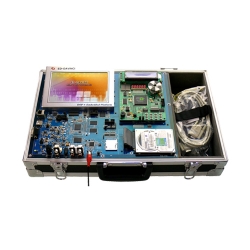
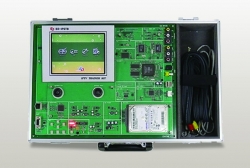
PC Based RFID Trainer ED-1450

Cod: ED-1450


Brosura produs PDF, 0.93 Mb

Descriere

CONFIGURATION

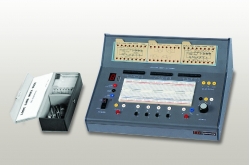
  • ED-1450 : PC Based RFID Trainer
    • Number of Modules : 2ea
    • Module Dimension : 290(W) x 210(H) x 26(D)mm
  • Required System
    • DS-1410 : Docking Station(Option)
      • Please refer to page 24 on DS-1410 specifications
    • CBIS-1400 : Computer Based Instrument System(Option)
      • Please refer to page 22 on CBIS-1400 specifications
    • Computer(Option)


Features:

  • The PC based RFID Trainer ED-1450 is a complete training system of total 2 Experimental Modules for RFID basic principles and application experiments.
  • Basically, ED-1450 model is designed for use by connecting to DS-1410 Docking Station(Option). PC connection through the Docking Station enables contact control on MMI(HMI) based software. It is also used together with CBIS-1400(Option) for realtime measurements on the computer screen.
  • The electronic manual operable on PC comes with ED-1450 and e-learning is optimized by remote control of student’s operating program and evaluation of student’s online report in real time.
  • Through DS-1410, it provides Variable Power Supply(VPS), Function Generator(FG), Analog Output, Digital Output needed for experiments.
  • ISO/IEC 14443/15693/1800-3
  • Operating Range : 125kHz(within 70mm), 13.56MHz(within 70mm)
  • Anti Collision function
  • Tag : 125kHz(Read Only Tag), 13.56MHz(Read / Write Tag)


Alte produse ED

COMPLETE MOTOR/GENERATOR TRAINING SYSTEM ED-5100

• Complete Motor/Generator Training System
• Various load characteristics(Resistance, L/C Reactance and Torque)
• Selectable System(ED-5100-1, ED-5100-2, ED-5100-3 or Full Set)


LON DEVICE DEVELOPMENT KIT ED-5960

• Home network based experiments suitable for ubiquitous computing
• Integrated ubiquitous device using ZigBee/RFID and finger print recognition
• Designed to help develop home network on the ground of Lon Protocol
• Equipped with each PLC module(Power Line Communication) for home network
• Related experiments through Neuron C and MICOM programming


MICROSTRIP LINE TRAINER ED-3300

• Helps understand theories on the Microstrip Line Theory and Microwave Elements Design
• Composed of 22 types of modules such as VCO using Coupler, Divider, Circulator, Attenuator and Filter
• SWR Detector, Modulation, Transmission/Reception, Detector, Self-Oscillation functions


ELECTRONIC COMMUNICATION TRAINER ED-2950

• 10 experimental modules with a mainframe console
• Basic concepts on the communication systems
• Experiments on the broadcast frequency band tuning
• Generation of AM and FM waves and detection theory


DIGITAL COMMUNICATION TRAINER ED-2970

• Modularized by the function of digital communication circuits
• FSK, ASK, PSK, QPSK and digital communication principles
• 12 types of modules including a power supply unit


FLEXIBLE MANUFACTURING SYSTEM ED-FMS1

• Stores at the cell designated by crane
• Stores according to color and materials
• Selecting and taking at the time of cell is full


PULSE/DIGITAL COMMUNICATION TRAINER ED-2920

• Modularized by each communicarion type
• PAM, PTM, PCM, DPCM, ADPCM, LDM, ADM, Delta-sigma
• No need to have additional generators (built-in power supply and signal source)
• Can display the test point and measure signals using an oscilloscope


COMPONENTS OF HYDRAULICS TRANSPARENCY THT-7964-1

• Maximum Operating Pressure : 3Mpa(30kgf/cm2)
• Hose’s Diameter : Outside ø6/Inside ø4
• Hose’s Length : 1500mm
• Rectangular Block Type


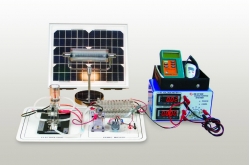
NEW & RENEWABLE ENERGY TRAINER ED-9720

• Conversion experiments on the produced energy(power production/processing)
• Characteristics of Solar Cell module’s voltage and current
• Alarm beep for wrong wire placement
• Voltmeter and ammeter as included for measuring AC and DC
• Control by PC and waveform and graph output


MOTOR / GENERATOR TRAINER UNIT MG-5216

• RIM’s no-load power factor and load power factor
• Load characteristics of separately excited DC shunt-wound generator
• No-load saturation characteristics of generator
• DC shunt-wound generator’s loss and power factor