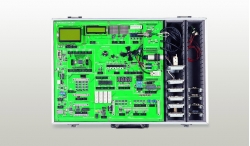
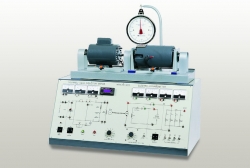
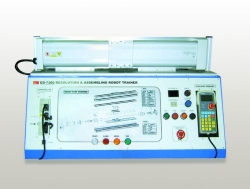
Stepping Motor Trainer ED-4301

Cod: ED-4301


Brosura produs PDF, 0.56 Mb

Descriere

EXPERIMENTS

  • Position control by step operation
  • Position control by continuous operation
  • Angle control by step operation
  • Angle control by photo sensor
  • Characteristics by phase excitation changes
  • Dynamic torque characteristics of stepping motor using frequency modulation
  • Wave form measurement using oscilloscope
  • Speed control by control S/W
  • Angle control by simulation S/W


SPECIFICATIONS

COMPUTER CONTROL

  • Step/continuous operation by Control Program
  • Direct/reverse rotation operation by Control Program
  • Output pulse frequency operation by Control Program
  • On-line, real time control by RS-232C


STEPPING MOTOR : 2EA

  • 2-phase HB type, unipolar operation, 0~2000PPS
  • PWM constant-current driver
  • LM GUIDE operation(position control) and Circular Board operation(angle control)
  • LM GUIDE(1set)
    • Ball screw distance : Over 200mm
    • Protection Circuit By Photo Sensor for exceeding the Range
  • Rotary Encoder
    • 400/Rev, built-in signal output terminal
    • LCD display device(rotation angle and motion step indication)


MANUAL CONTROL

  • Step/continuous operation by the values set manually
  • Direct/reverse rotation operation by the values set manually
  • Output pulse frequency Operation by the values set manually


ACCESSORIES

  • PC Software : 1ea
  • AC Power Cord : 1ea
  • Experimental Manual : 1ea


Features:

  • Graphical display of functonal block diagram on the system suface
  • Real-time monitoring and control by PC Control Program
  • LM Guide and Rotary Encoder for position control
  • Displays moving distance and angle data using LCD
 

Alte produse ED

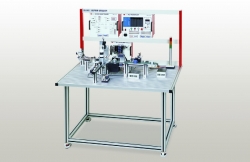
FACTORY AUTOMATION TRAINER ED-4031

• Comprehension of basic production automation processes such as transfer, fabrication, classification, inspection and storage
• Convenient wiring and pipe arrangement with a label of each component such as sensors and actuators
• PLC training system function(various types of sequence actions through a change in PLC control program
• Counter/timer function and motor control by PLC or without PLC(electrical method)
• Aluminum profile worktable & control modules for easy mounting


4-AXIS RECTANGULAR COORDINATES ROBOT TRAINER ED-XYZ

• Experiments on the 4-axis Cartesian robot
• Teaching pendant in 7.5wide color touch panel
• Standard language for the international industrial robot
• Simulation software in three dimension


DIGITAL COMMUNICATION TRAINER ED-2970

• Modularized by the function of digital communication circuits
• FSK, ASK, PSK, QPSK and digital communication principles
• 12 types of modules including a power supply unit


FLEXIBLE MANUFACTURING SYSTEM ED-FMS1

• Stores at the cell designated by crane
• Stores according to color and materials
• Selecting and taking at the time of cell is full


SQUIRREL CAGE INDUCTION MOTOR/ DC GENERATOR MG-5212

• Start and load characteristics of squirrel cage induction motor
• Alteration of the rotative directions of squirrel cage Induction Motor
• Slip speed and torque of induction motor
• Induction motor’s no-load power factor and load power facto


DC SERVO MOTOR TRAINER ED-4302

• Display of the rotational speed and angle data using LCD
• PC control and waveform output functions
• Portable type with Aluminum Carrying Case


MULTIPLEXED COMMUNICATION TRAINER ED-2990

• PLL and Digital Synthesizer
• PAM, PCM, FDM and FSK Modem
• 10types of module including DC Power Supply


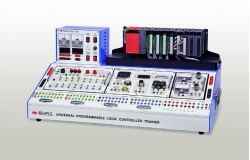
UNIVERSAL PLC TRAINER ED-UPLC

• Docking System architecture separating the main body from PLC modules
• Various types of Programmable Logic Controller experiments
• Modular structure for convenient storage and mobility
• Built-in multi connection device compatible with world’s famous PLC brands


CONVEYOR CONTROL SIMULATION UNIT CU-4001

• Belt-type conveyor simulator
• Control Modes : manual or automatic by programmable Logic Controller
• Three photo sensors and two motion solenoids


HOME NETWORK DESIGN PLATFORM ED-5965

• Designed to help develop network devices on the basis of Lon Protocol
• Control of each device installed in the field through power line communication
• Related experiments through Neuron C and MICOM programming
• Home network control in utilization of LabVIEW