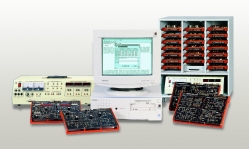
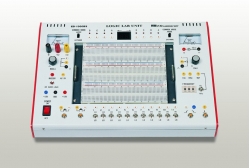
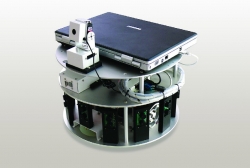
Embedded Software Design Platform ED-255EK

Cod: ED-255EK


Brosura produs PDF, 0.89 Mb

Descriere

EXPERIMENTS

  • Development Environment
    • Target Board, Host PC setup and connection
    • Host PC’s Development Tool setup, Environment setup (minicom, bootp, tftp, nfs, etc.)
    • Cross Compiler and ARM Tool Chain setup
  • Boot Loader
    • u-boot compile and Boot Loader image creation
    • Boot Loader’s function and command processing
    • Memory map setup and Boot Loader porting
    • Hardware debugging method through Boot Loader
    • Board porting using Boot Loader and JTAG
    • Overview and structure of Linux Kernel
  • Kernel
    • Kernel source download and composition
    • TFTP/NFS server build
    • Embedded Linux porting and Kernel environment configuration
    • Porting to device such as TFT LCD, Ethernet, Serial, PCMCIA, USB, CF, MMC/SD, AC97, etc.
  • File System
    • Embedded Linux compile
    • Composition of Linux file system
    • NFS Booting used at a development stage
  • Development stage
    • Ramdisk creation
    • Ramdisk booting for completion of development
    • Creation and mount of JFFS2 file system
  • FPGA/IO Module Device Driver
    • Concept of Device Driver
    • Basic Character Device Driver
    • LED Device Driver
    • Six-FND Device Driver
    • 20x2 Line Text LCD Device Driver
    • 4x4 Key Switch Device Driver
    • FPGA Design and Device Driver
    • CMOS Camera Device Driver
  • Application Program
    • Program Compile using Development Utilities
    • Device Driver application program(Programming)
    • TCP/IP program(Programming)
    • Goahead Web Server porting
    • Board Control using CGI
  • GUI Program
    • Qt
    • Qt/E and Qtopia
    • Qt Development Environment setup
    • Qtopia Compile
    • Porting to a target board and testing program using NFS server
    • System Packaging
 

Alte produse ED

WOUND-ROTOR INDUCTION MOTOR/ DC GENERATOR MG-5213

• Load characteristics of shunt-wound and compound generators
• Generator’s speed and output by winding type
• Loss and efficiency comparisons by winding type


LON DEVICE DEVELOPMENT KIT ED-5960

• Home network based experiments suitable for ubiquitous computing
• Integrated ubiquitous device using ZigBee/RFID and finger print recognition
• Designed to help develop home network on the ground of Lon Protocol
• Equipped with each PLC module(Power Line Communication) for home network
• Related experiments through Neuron C and MICOM programming


ADSL TRAINING SYSTEM ED-NET-2

• Study of functions, characteristics, installation, repair and maintenance of basic ADSL components such as Telephone Exchange, Splitter, DSLAM, ADSL Modem, HUB and LAN Card
• Network structure through interworking experiments with Internet and capability of Internet usage and simple programming
• Capable of interworking experiments with ED-NET-3(LAN Training System)


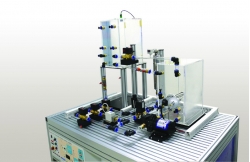
COMPUTER-INTEGRATED MANUFACTURING TRAINER ED-CIM

• Computer-Integrated Manufacturing Training System under the application of advanced control technology for real field experiences
• Capable of "per unit" configuration into the two or more processes, or entire processes for customized experiments by combining each process


MOTOR / GENERATOR TRAINER UNIT MG-5216

• RIM’s no-load power factor and load power factor
• Load characteristics of separately excited DC shunt-wound generator
• No-load saturation characteristics of generator
• DC shunt-wound generator’s loss and power factor


ELECTRONICS DEMONSTRATION SYSTEM ED-2300

• 24 Experimental Boards in two sections : (A) Semiconductor and (B) Electronic Circuit
• Experimental Board rack and board storage cabinet


ANALOG LAB UNIT ED-2200

• AF Generator and Frequency Counter(built-in)
• Dual DC Power Supply(5/6V, 9/12/15V)
• Decade Capacitor(2 digits) and Programmable Resistor


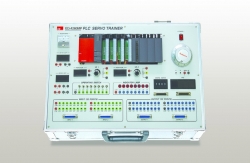
PORTABLE PLC TRAINER ED-4260P

• Composed of essential devices for Programmable Logic Controller I/O commands
• LD (Ladder Diagram), IL (Instruction List), SFC (Sequential Function)
• Built-in Simulator to train on the encoder’s principle and functions
• Stepping motor and DC motor installed as standard (forward/reverse rotation, linear movement)
• Capable of network configuration by CPU and Remote I/C Link


SEQUENCE CONTROL TRAINER ED-4010

• Realistic arrangement of materials used for contact sequence
• Indication of each element’s symbol on the panel


SQUIRREL CAGE INDUCTION MOTOR/ DC GENERATOR MG-5212

• Start and load characteristics of squirrel cage induction motor
• Alteration of the rotative directions of squirrel cage Induction Motor
• Slip speed and torque of induction motor
• Induction motor’s no-load power factor and load power facto