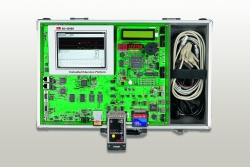
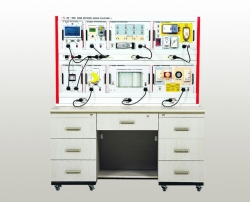
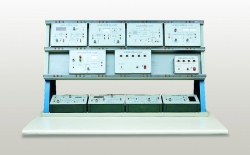
Robot Assembly Kit Trainer ED-7271

Cod: ED-7271


Brosura produs PDF, 1.24 Mb

Descriere

EXPERIMENTS

  • Understanding of the Artificial Intelligence Robot
  • Classification of technologies applied to the Artificial Intelligence Robot
  • Basic structure, mechanism and strength and weakness of the robot
  • Principle and practice of  the sensor modules
  • Types and characteristics of  the actuators(DC Servo Motor, Step Motor, RC Motor)
  • Image processing experiments using the CCD Image Sensor(Digital Image Processing theory and pattern/color recognition principles and experiments)
  • Applied experiments using the Intelligent Robot Kit


Features:

  • 10 types of sensors, 3 types of actuator modules and 4 types of application modules essential for the intelligent robot
  • System structure for seizing the essence of artificial intelligence robots
  • Enriched examples for the beginning level to an advanced level in the robot class
  • Easy to mount modules by the clamping device
  • USB high speed(480Mbps) interface
  • Extensive learning for the sensors being used in the field of Ubiquitous and Home Network
  • Image processing practice using USB Camera
  • Application experiment using MSRDS(Microsoft Robotics Developer Studio)


Alte produse ED

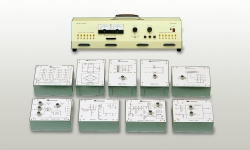
ELECTRONIC COMMUNICATION TRAINER ED-2950

• 10 experimental modules with a mainframe console
• Basic concepts on the communication systems
• Experiments on the broadcast frequency band tuning
• Generation of AM and FM waves and detection theory


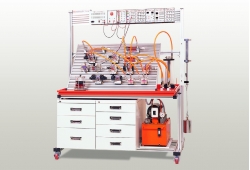
TRANSPARENT HYDRAULIC TRAINER ED-7964

• Convenient parts fixation by ‘one-touch lever’ bases and aluminum profile structure
• Efficient space utilization by mounting parts horizontally/vertically
• 41 transparent hydraulic and electrical/electronic parts plus various optional components.
• Various hydraulic devices and components for Flexible Manufacturing System


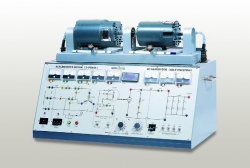
SYNCHRONOUS MOTOR(3-PHASE)/DC GENERATOR MG-5215

• Start and Sync characteristics of synchronous motor
• V-curve characteristics of synchronous motor
• Synchronous motor’s loss and efficiency
• Load characteristics of self-excited shunt-wound generator


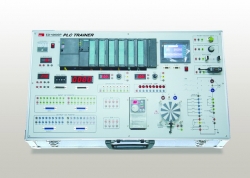
PORTABLE SIEMENS PLC TRAINER ED-4260SP

• Comprehensive experiments on PLC, Inverter, Touch Panel and Sensor
• Various programming experiments including digital numeric value
• Aluminum case structure for convenient storage and mobility
• Built-in DC power supply as part of system for handy practices
• All-in-one training system which comes with the inverter and touch panel


EMBEDDED SOFTWARE DESIGN PLATFORM ED-255EK

• Basic to advanced learning courses for Embedded Linux
• Intel PXA255(400MHz) high-performance microprocessor
• 6.4TFT LCD, Ethernet 2port, Serial 3port, PCMCIA/CF/MMC interfaces
• FPGA Chip(Altera Cyclone 120,000Gate) mounted for SoC experiments
• Reliable hardware and abundant experiment contents for programming


DC SERVO TRAINER ED-4400B

• Analog feedback loop & DC servo system
• Modularized by the function of servo circuits
• Overload protection for the servo amp's and power supply's output


MICROPROCESSOR COMBO ED-4512

• Mountable 5 type of MCU(8051,PIC, Atmega128, Atmega8535, Upd78f0547)
• Practice of various communications such as RS-232 USB and Ethernet
• Practice from basic I/O exercises to sensor application exercises with 5 MCU’s
• Possible of various practice by using of Bread Board and I/O Expansion Port
• Storage of sensor data display and Excel data using UI(LabVIEW)


FUEL CELL TRAINER ED-9740

• Fuel cell generation using photovoltaic
• Complete disassembly and assembly of the fuel cell
• Current and voltage measurement for PEM Fuel Cell Stack according to each of Cell
• Power production experiment using PEM Fuel cell


HOME NETWORK DESIGN PLATFORM ED-5965

• Designed to help develop network devices on the basis of Lon Protocol
• Control of each device installed in the field through power line communication
• Related experiments through Neuron C and MICOM programming
• Home network control in utilization of LabVIEW


AM TRANSCEIVER TRAINER ED-3400

• HF band(3.5~12MHz)
• Transmitter and Receiver modules for each circuit stage
• Graphical latour of the block diagrams, plus LEDs and test points
• Covers Push-to-Talk and helps understand short wave communications