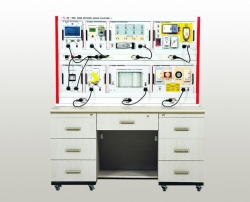
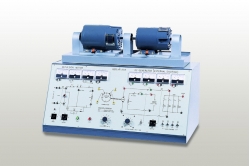
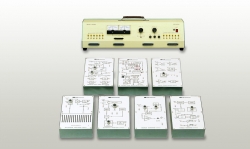
Pulse/Digital Communication Trainer ED-2920

Cod: ED-2920


Brosura produs PDF, 0.99 Mb

Descriere

EXPERIMENTS

  • PAM
    • To Understand PAM Signal Generation Which Makes an Example of Natural and Flat-Top
    • To Know the Impact of Sampling Signal Frequency on PAM Signal At the Time Domain
  • PTM
    • To Understand PTM (Pulse Time Modulation) Signal Generation Methods
    • To Understand PTM Signal Characteristics at the Time Domain
    • To Understand the Relationship Between PWM Signal and PPM Signal
  • PCM
    • To Understand A/D and D/A Conversion Processes
    • To Understand the cCounter-type A/D Conversion System
    • To Understand the Parallel-type D/A Conversion System
  • PCM
    • To Understand the Successive Approximation-type A/D Conversion System
    • To Understand PCM Signal Transmission Methods
  • PCM
    • To Understand the µ-law and µ-law Companding Characteristic Curves
    • To Understand the Influence of Companding on Demodulation Signal
  • DPCM
    • To Know the Methods of DPCM Signal Generation and Message Signal Demodulation
    • To Know the Offset Binary Code, 2’s Complement Code and Signed Binary Code
  • ADPCM
    • To Know the Relationship Between PCM CODEC’s Operation Principle and Its Timing
    • To Know the Relationship Between ADPCM System’s Operation Principle and ADPCM Transcoder’s Timing Diagram
  • LDM
    • To Know LDM Signal Generation and Message Signal Demodulation Methods
    • To Know the Shapes of Slope Overload Noise and Granular Noise Generated in ?M System
  • ADM
    • To Know ADM Signal Generation and Message Signal Demodulation Methods
    • To Know the Methods of Oblique Overload Noise Prevention in CVSD Demodulation System
  • ?-?
    • To Know ?-? Demodulation Principles and S/N Improvement Methods
    • To Know the Impact of Oversampling and Noise Shaping On the S/N Ratio at  ?-?Eemodulation


Features:

  • Modularized by each communicarion type
  • PAM, PTM, PCM, DPCM, ADPCM, LDM, ADM, Delta-sigma
  • No need to have additional generators (built-in power supply and signal source)
  • Can display the test point and measure signals using an oscilloscope
 

Alte produse ED

EMBEDDED BASED HOME NETWORK TRAINER ED-5967

• Home network control in liaison with Embedded PXA 255/270/272/320
• Power line communication and ZigBee modules with Multi Port in use together
• Embedded


STEPPING MOTOR TRAINER ED-4301

• Graphical display of functonal block diagram on the system suface
• Real-time monitoring and control by PC Control Program
• LM Guide and Rotary Encoder for position control
• Displays moving distance and angle data using LCD


TRANSPARENT HYDRAULIC TRAINER ED-7964

• Convenient parts fixation by ‘one-touch lever’ bases and aluminum profile structure
• Efficient space utilization by mounting parts horizontally/vertically
• 41 transparent hydraulic and electrical/electronic parts plus various optional components.
• Various hydraulic devices and components for Flexible Manufacturing System


EMBEDDED & DSP DESIGN PLATFORM ED-DAVINCI

• One-stop training kit for embedded system, DSP and FPGA
• 7" Wide TFT LCD, 10/100 Ethernet 1Port, Serial 1Port, SD/MMC, ATA and other interfaces


HOME NETWORK DESIGN PLATFORM ED-5965

• Designed to help develop network devices on the basis of Lon Protocol
• Control of each device installed in the field through power line communication
• Related experiments through Neuron C and MICOM programming
• Home network control in utilization of LabVIEW


SENSOR TRAINER FOR FACTORY AUTOMATION ED-6830

• Integrated sensor training system covering electricity, electronics, automation and chemistry
• Consists of 24 sensor modules, 8 application modules, 5 conversion modules, 2 signal prossing modules, 11 pneumatic components and power supply
• PC-based control for convenient, effective data collection and analysis
• Application module experiments(illumination, pneumatic auto coor, motor, temperature) for enhancing field experiences


BASIC ELECTRICITY & ELECTRONICS TRAINER ED-2000E

• 14 experimental boards with mounting rack and storage cabinet
• Analysis of DC and AC circuits
• Electromagnetics experiments


WOUND-ROTOR INDUCTION MOTOR/ DC GENERATOR MG-5213

• Load characteristics of shunt-wound and compound generators
• Generator’s speed and output by winding type
• Loss and efficiency comparisons by winding type


MOTOR / GENERATOR TRAINER UNIT MG-5216

• RIM’s no-load power factor and load power factor
• Load characteristics of separately excited DC shunt-wound generator
• No-load saturation characteristics of generator
• DC shunt-wound generator’s loss and power factor


TELECOMMUNICATION TRAINER ED-2960

• 7 experimental modules with a mainframe console
• Harmonic Analysis and Superheterodyne Receiver experiments
• PCM(TDM), Sample Hold, and Delta Modulation experiments