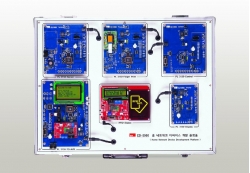
Intelligent Education Robot Platform ED-7270

Cod: ED-7270


Brosura produs PDF, 1.08 Mb

Descriere

EXPERIMENTS

1st STEP

  • Concept and definition of the Intelligent Robot
  • Structure and principle of the Intelligent Robot


2nd STEP

  • Principle and practice for the Intelligent Robot’s sensor
  • Voice recognition and image sensor
  • Programming through the dialogue-type language


3rd STEP

  • Operation of the Dialogue-based Robot
  • Ubiquitous environment based control
  • Autonomous movement and object recognition


4th STEP

  • Practice on movement along optimized routes
  • Practice on remote network control


Features:

  • Insight into the Intelligent Robot and step-by step practices
  • Various services through the functions of ZigBee and RFID Reader
  • Recognition of the robot’s position and direction
  • Various training contents using the dialogue language(programs)
  • Image processing by the Fan/Tilt USB Camera
  • Human-friendly design to interact with the human being
  • Ideal for the Ubiquitous and Home Network based experiments
  • Home security experiments on utilization of its unattended security function
  • Robot control API using Visual C++ and control functions by Visual Basic Scripter
  • Next Generation Cell(Lithium Lon) - compact size and increase in life time


Alte produse ED

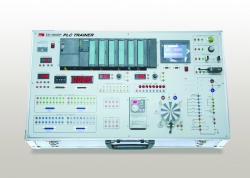
PORTABLE SIEMENS PLC TRAINER ED-4260SP

• Comprehensive experiments on PLC, Inverter, Touch Panel and Sensor
• Various programming experiments including digital numeric value
• Aluminum case structure for convenient storage and mobility
• Built-in DC power supply as part of system for handy practices
• All-in-one training system which comes with the inverter and touch panel


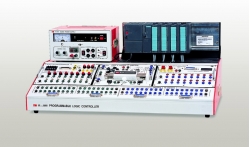
SIEMENS SIMATIC STEP7-300 MODULAR PLC TRAINER ED-4260S

• SIMATIC STEP7-300 PLC programming and execution
• Modularization of the devices dssential for PLC I/O commands
• Experiments for basic command and various application program
• Binary data experiments with 4digits digital switch and display unit
• Customizable for various types of STEP7-300 series CPU


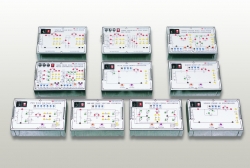
POWER ELECTRONICS TRAINER ED-2040

• Covers essential circuits needed to practice power electronics circuits
• Modular type with aluminum carrying case
• Optional rack to be customized upon requst


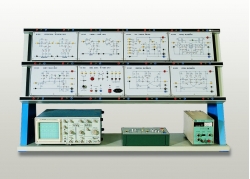
PULSE CIRCUIT TRAINER ED-6400

• Modular system with experimental rack
• Pulse Generation, synthesis and conversion
• Built-in signal source and DC power supply


LOGIC/DIGITAL CIRCUIT TRAINER ED-1400A

• Capable of performing Logic monitoring functions
• Graphical presentation of functional diagram on each module
• 15 modules each for TTL or CMOS IC type


MODULAR SEQUENCE TRAINER ED-4010P

• Aluminum Profile-based work table structure for mounting the components
• Manufacturing electrical composition elements in modular type using actual components
• Wiring practices and circuit composition to configure sequence composition elements on the working board
• Various contents linked with e-learning such as wiring, operation and etc.


LON DEVICE DEVELOPMENT KIT ED-5960

• Home network based experiments suitable for ubiquitous computing
• Integrated ubiquitous device using ZigBee/RFID and finger print recognition
• Designed to help develop home network on the ground of Lon Protocol
• Equipped with each PLC module(Power Line Communication) for home network
• Related experiments through Neuron C and MICOM programming


AC SERVO MOTOR TRAINER ED-4303

• Experiments on Servo Motor control techniques using Servo Driver
• Aluminum carrying case for convenient storage and mobility
• JOG operation, PLC control operation, PC control operation
• Various types of control elements easily to be mounted
• Capable of checking normal operating voltage / over current by voltmeter and ammeter


LOGIC TRAINER ED-1100A

• Unique logic cards(TTL/CMOS)
• Internal pulse outputs
• 3-stage Logic Monitor
• BCD indication


MOTOR / GENERATOR TRAINER UNIT MG-5216

• RIM’s no-load power factor and load power factor
• Load characteristics of separately excited DC shunt-wound generator
• No-load saturation characteristics of generator
• DC shunt-wound generator’s loss and power factor