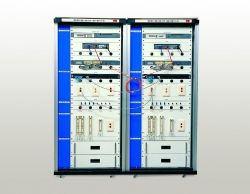
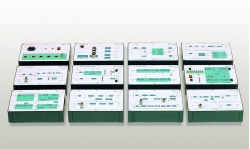
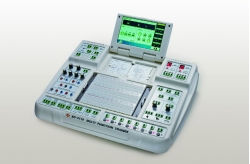
FM Transceiver Trainer ED-3600

Cod: ED-3600


Brosura produs PDF, 0.49 Mb
     

Descriere

TRANSMITTER SECTION

  • Frequency Range : 88~108MHz(2-channels)
  • RF Output : 100mW
  • Modulation Mode : Reactance Modulation
  • Frequency Control Mode : PLL
  • Deviation : ±75kHz
  • Audio Input : 0~-40dB for Microphone

RECEIVER SECTION

  • Frequency Range : 88~108MHz(FM Broadcasting Band)
  • Sensitivity : 2µV
  • Intermediate Frequency : 10.7MHz
  • AF Output : 0dBm

STEREO SECTION

  • Pilot Frequency : 19kHz 5Hz
  • Separation
    • Above 50dB : 400Hz~1kHz
    • Above 40dB : 100Hz~10kHz
  • Frequency Response : 50Hz~15kHz
  • AF Output : 2Watts x 2-Channels

GENERAL CHARACTERISTICS

  • Input Voltage : DC ±15V, 0.5A Max.
  • Dimension
    • Module : 420(W)x302(H) x 47(D)mm
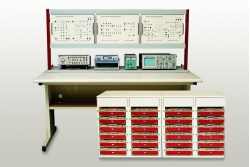
    • Board Rack (BR-3) : 1480(W) x 620(H) x 320(D)mm
  • System Weight : 41kg

Features:

  • Realistic Simulation of FM stereo broadcast
  • Graphical layout of block diagrams, display elements and test points
  • Covers the principles of FM stereo encoder and decoder
  • Experiments on stereo amplifier (equalizer, tone control, pre-amp, etc.)


Alte produse ED

MODULAR SEQUENCE TRAINER ED-4010P

• Aluminum Profile-based work table structure for mounting the components
• Manufacturing electrical composition elements in modular type using actual components
• Wiring practices and circuit composition to configure sequence composition elements on the working board
• Various contents linked with e-learning such as wiring, operation and etc.


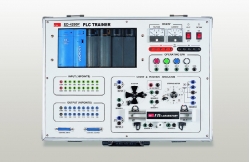
PORTABLE PLC TRAINER ED-4260P

• Composed of essential devices for Programmable Logic Controller I/O commands
• LD (Ladder Diagram), IL (Instruction List), SFC (Sequential Function)
• Built-in Simulator to train on the encoder’s principle and functions
• Stepping motor and DC motor installed as standard (forward/reverse rotation, linear movement)
• Capable of network configuration by CPU and Remote I/C Link


EMBEDDED SOFTWARE DESIGN MULTI PLATFORM ED-270M

• Foundation for the Ubiquitous System Build
• Intel PXA 270 high performance processors
• 6.4TFT LCD, Ethernet 3Port, Serial 3Port, PCMCIA/CF/MMC interfaces
• FPGA Chip Altera Cyclone 4,000 LEs(12,000 LEs Option) for SoC courses
• Processor Core Board & CMOS Image Sensor


MICROPROCESSOR COMBO II ED-4513

• Mountable 5pieces MCU(8051,PIC, ATmega128, ATmega8535, upd78F0547)
• Practice of various communications such as RS-232 USB and Ethernet
• SoC experiments using the default FPGA (EP1C4F324)
• Storage of sensor data display and excel data using UI(LabVIEW)


PC BASED DIGITAL COMMUNICATION TRAINER ED-1440

• The Electronic Manual operable on PC comes with ED-1440 and e-learning is optimized by remote control of student’s operating program and evaluation of student’s online peport in real time.
• Through DS-1410, it provides Variable Power Supply(VPS), Function Generator(FG), Analog Output, Digital Output needed for experiments.


MICROWAVE TRAINER ED-3000

• Gunn Oscillator base system
• Directional Coupler & Horn Antenna
• Frequency : 9GHz~11GHz (X-Band)
• Microwave output : 15mV


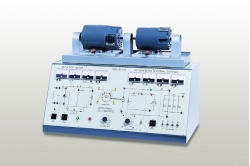
INVERTER MOTOR TRAINER ED-4304

• Practical training on inverter and 3-phase induction motor operations
• Control experiments using a PLC module (in use of D/A module)
• Feasible contact-type PLC control
• Carrying case type structure for convenient storage and mobility


FLEXIBLE MANUFACTURING SYSTEM ED-FMS1

• Stores at the cell designated by crane
• Stores according to color and materials
• Selecting and taking at the time of cell is full


EMBEDDED & DSP DESIGN PLATFORM ED-DAVINCI

• One-stop training kit for embedded system, DSP and FPGA
• 7" Wide TFT LCD, 10/100 Ethernet 1Port, Serial 1Port, SD/MMC, ATA and other interfaces


LON DEVICE DEVELOPMENT KIT ED-5960

• Home network based experiments suitable for ubiquitous computing
• Integrated ubiquitous device using ZigBee/RFID and finger print recognition
• Designed to help develop home network on the ground of Lon Protocol
• Equipped with each PLC module(Power Line Communication) for home network
• Related experiments through Neuron C and MICOM programming