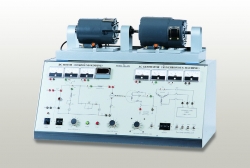
Portable PLC Trainer ED-4260P

Code: ED-4260P


Datasheet PDF, 0.6 Mb

Description

PLC

  • Control Method
    • Stored Program, Repetitive Operation, Pre-timed
  • Operation, Interrupt Operation
  • I/O Control Type : Scan synchronized batch processing
  • Program Language
    • LD(Ladder Diagram), IL(Instruction List), SFC(Sequential Function Chart)
  • Number of Commands
    • Operator : LD 13ea, IL 21ea
    • Basic Function : 194ea
    • Basic Function Block : 11ea
    • Special Function Block : Exclusive use for the special function module
    • Processing Speed : Operator 0.5µs/command

COUNTER & POSITION UNIT

  • DC Motor : 1ea
  • Stepping Motor : 1ea
  • Pinion Gear Slide Unit : 1ea
  • e-shaped Photo Sensor(built-in)
  • Position-detecting Limit Sensor for pinion slide unit(built-in)

MAIN PANEL

  • Structure
    • Aluminum carrying case type
  • Fixed Output Power Supply
    • Main : AC 220V, 3A
    • DC Power Source
      • 24V, 2A(standalone type switch mounted)
    • PLC Power Source
      • AC 220V(standalone type switch mounted)
    • Voltmeter : DC 30V
    • Voltage Indication : DCV-Meter x 1ea
    • Ammeter : 5A
    • Current Indication : DCA-Meter x 1ea
  • Input Voltage
    • AC 220V, 50/60Hz
  • Digital Input
    • Input Contact : 16 points
    • Connector for linking PLC input : 1ea
  • Digital Output
    • Output Contact : 16 points
    • Connector for linking PLC output : 1ea
  • Switch Input
    • Push Button : 4ea

Features:

  • Composed of essential devices for Programmable Logic Controller I/O commands
  • LD (Ladder Diagram), IL (Instruction List), SFC (Sequential Function)
  • Built-in Simulator to train on the encoder’s principle and functions
  • Stepping motor and DC motor installed as standard (forward/reverse rotation, linear movement)
  • Capable of network configuration by CPU and Remote I/C Link
 

More products ED

MINI MPS (MODULAR PRODUCTION SYSTEM) ED-9160

• Organization of various control elements in complexity for applied technology
• Total of 6 processes comprising supply, Sensor, Stopper, Absorption & Transfer, Conveyor and Loading
• Built-in control elements covering mechanics, electricity, and electronics
• Control circuit for simple and high speed data transmission in the USB type


DIGITAL COMMUNICATION TRAINER ED-2970

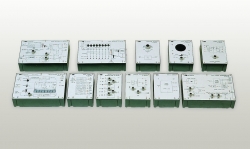
• Modularized by the function of digital communication circuits
• FSK, ASK, PSK, QPSK and digital communication principles
• 12 types of modules including a power supply unit


CONVEYOR CONTROL SIMULATION UNIT CU-4001

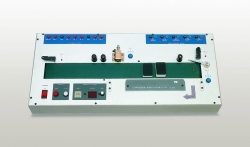
• Belt-type conveyor simulator
• Control Modes : manual or automatic by programmable Logic Controller
• Three photo sensors and two motion solenoids


LOGIC TRAINER ED-1100A

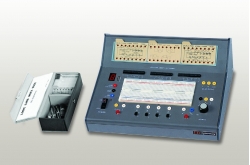
• Unique logic cards(TTL/CMOS)
• Internal pulse outputs
• 3-stage Logic Monitor
• BCD indication


SEQUENCE CONTROL TRAINER ED-4010

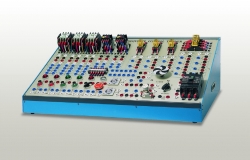
• Realistic arrangement of materials used for contact sequence
• Indication of each element’s symbol on the panel


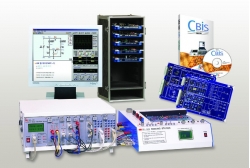
PC BASED ANALOG COMMUNICATION TRAINER ED-1460

• Interlocking system package with CBIS-1400 and DS-1410 Models (Options)
• Experiments on a measurable low frequency bandwidth
• Realistic experiments on modulation and demodulation
• Verification of the output waveform on PC engaged with CBIS-1400 Model


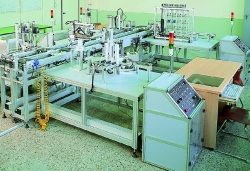
FLEXIBLE MANUFACTURING SYSTEM ED-FMS1

• Stores at the cell designated by crane
• Stores according to color and materials
• Selecting and taking at the time of cell is full


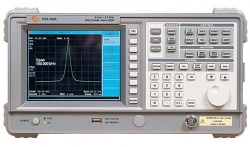
ED PSA-6000 SPECTRAL ANALYZER 9 KHZ..6.2GHZ

• High-performance digital synthesizer method
• Wide Frequency Coverage : 9 kHz ~ 6.2 GHz
• Superior Resolution : Minimum 1 Hz
• Compact & Portable size
• Wide Input Dynamic Range : -105 ~ 20 dBm
• Various and Convenient Interfaces : USB, LAN


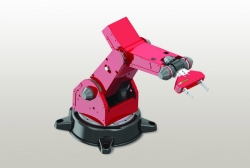
5-AXIS ARM ROBOT TRAINER ED-7255

• Consists of one gripper and 5-axis vertical multi joints
• Absolute-type RVDT Position Sensor applied to each axis and requires no Limit switch
• High performance CPU enables real-time control of each axis
• PID gain tuning and real-time control


DC MOTOR/AC GENERATOR MG-5214

• DC motor’s load characteristics
• DC motor’s loss and efficiency
• Alteration of the motor’s rotative directions
• Motor’s speed and torque