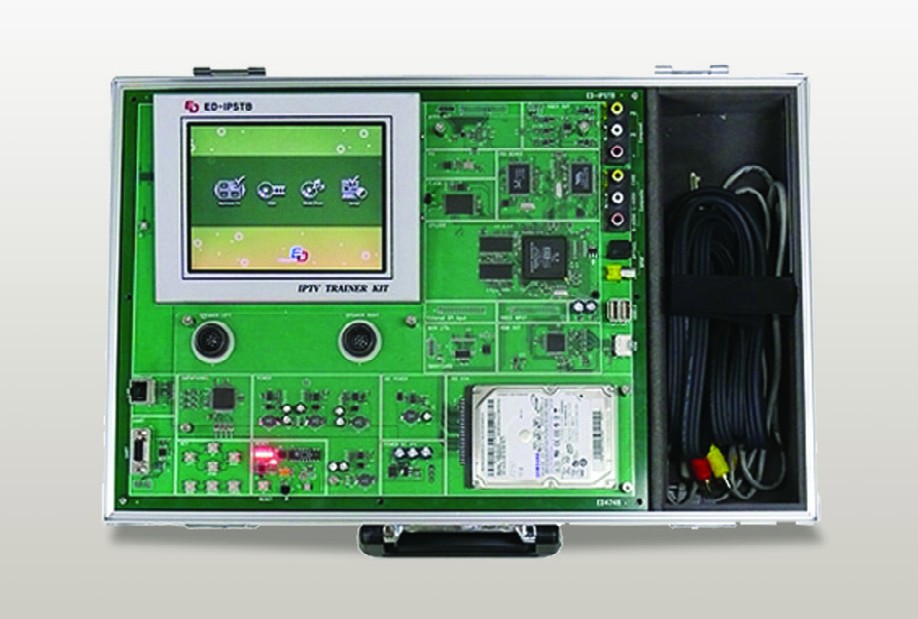
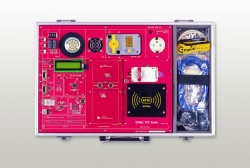
IPTV Trainer Kit EP-IPSTB

Code: EP-IPSTB


Datasheet PDF, 0.77 Mb

Description

EXPERIMENTS

  • Development Environment
    • Configuration and connection of the target board and host PC
    • Installation of development tool onto host PC and environment setup
    • Setup of Minicom environment and NFS system
  • Kernel / Bootloader
    • Bootloader image fusing onto the target board
    • Kernel config setup and Kernel compiling
  • File System
    • Kernel environment setup and compiling for the file system
    • Creation of file system images
    • Configuration of the file system environment for IPSTB
  • IPTV Server
    • Installation of Multicast server onto LINUX
    • Installation of Web server onto LINUX for VOD and EPG
    • Installation of Time server for synchronizing the service time
  • IPTV Application Programs
    • Design of XML and class for data communications
    • IPTV application programs and GUI design
    • Compiling and execution of IPTV application programs
    • Creation of Main Menu
    • Creation of Multicast Service
    • Creation of VOD Service
    • Creation of EPG Popup
    • Creation of Media Players
  • LINUX Device Driver
    • Working environment for LINUX device driver
    • Creation of device module program
    • Creation of remote controller and application programs
    • Creation of front panel driver
    • Creation of network driver


Features:

  • Best solution for IPTV platform and IPTV Digital Broadcasting System in applications and experiments
  • High-performance Microprocessor SIGMA EM8622 for powerful multimedia functions
  • IPTV Set-top Box, Media Player, Digital Multimedia Processing
  • Various types of media codec such as MPEG-4.10(H.264), WMV9, MP3, MPEG-2 and JPEG
  • DEMUX API provided to help develop SD/HD class digital broadcasting service


More products ED

FUEL CELL TRAINER ED-9740

• Fuel cell generation using photovoltaic
• Complete disassembly and assembly of the fuel cell
• Current and voltage measurement for PEM Fuel Cell Stack according to each of Cell
• Power production experiment using PEM Fuel cell


LOGIC/DIGITAL CIRCUIT TRAINER ED-1400A

• Capable of performing Logic monitoring functions
• Graphical presentation of functional diagram on each module
• 15 modules each for TTL or CMOS IC type


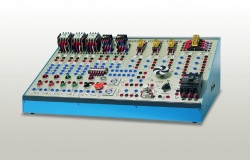
ALLEN-BRADLEY SLC-500 MODULAR PLC TRAINER ED-4260AB

• ALLEN-BRADLEY SLC-500 PLC programming and execution
• Modularization of the devices essential for PLC I/O commands
• Experiments for basic command and various application program
• Binary data experiments with 4digits digital switch and display unit
• Customizable for various types of SLC-500 Series CPU upon request


BASIC ELECTRICITY & ELECTRONICS TRAINER ED-2000E

• 14 experimental boards with mounting rack and storage cabinet
• Analysis of DC and AC circuits
• Electromagnetics experiments


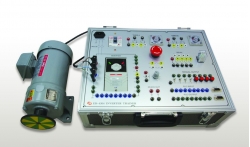
MOTOR / GENERATOR TRAINER UNIT MG-5216

• RIM’s no-load power factor and load power factor
• Load characteristics of separately excited DC shunt-wound generator
• No-load saturation characteristics of generator
• DC shunt-wound generator’s loss and power factor


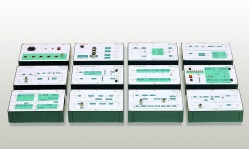
DIGITAL COMMUNICATION TRAINER ED-2970

• Modularized by the function of digital communication circuits
• FSK, ASK, PSK, QPSK and digital communication principles
• 12 types of modules including a power supply unit


ANTENNA TRAINER ED-3200

• 16 different types of Antenna
• RF source generation : 500MHz, 2GHz and 10GHz
• Software simulation of radiation Patterns and characteristics of Antenna
• Antenna Directional Coupler (Manual / Remote)


SCR TRAINER ED-5060

• SCR characteristics
• Rectifier and phase control
• Trigger and gate control
• Motor speed control


STEPPING MOTOR TRAINER ED-4301

• Graphical display of functonal block diagram on the system suface
• Real-time monitoring and control by PC Control Program
• LM Guide and Rotary Encoder for position control
• Displays moving distance and angle data using LCD


HOME NETWORK DESIGN PLATFORM ED-5965

• Designed to help develop network devices on the basis of Lon Protocol
• Control of each device installed in the field through power line communication
• Related experiments through Neuron C and MICOM programming
• Home network control in utilization of LabVIEW