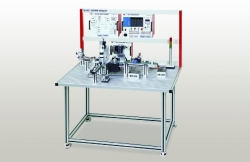
Stepping Motor Trainer ED-4301

Code: ED-4301


Datasheet PDF, 0.56 Mb

Description

EXPERIMENTS

  • Position control by step operation
  • Position control by continuous operation
  • Angle control by step operation
  • Angle control by photo sensor
  • Characteristics by phase excitation changes
  • Dynamic torque characteristics of stepping motor using frequency modulation
  • Wave form measurement using oscilloscope
  • Speed control by control S/W
  • Angle control by simulation S/W


SPECIFICATIONS

COMPUTER CONTROL

  • Step/continuous operation by Control Program
  • Direct/reverse rotation operation by Control Program
  • Output pulse frequency operation by Control Program
  • On-line, real time control by RS-232C


STEPPING MOTOR : 2EA

  • 2-phase HB type, unipolar operation, 0~2000PPS
  • PWM constant-current driver
  • LM GUIDE operation(position control) and Circular Board operation(angle control)
  • LM GUIDE(1set)
    • Ball screw distance : Over 200mm
    • Protection Circuit By Photo Sensor for exceeding the Range
  • Rotary Encoder
    • 400/Rev, built-in signal output terminal
    • LCD display device(rotation angle and motion step indication)


MANUAL CONTROL

  • Step/continuous operation by the values set manually
  • Direct/reverse rotation operation by the values set manually
  • Output pulse frequency Operation by the values set manually


ACCESSORIES

  • PC Software : 1ea
  • AC Power Cord : 1ea
  • Experimental Manual : 1ea


Features:

  • Graphical display of functonal block diagram on the system suface
  • Real-time monitoring and control by PC Control Program
  • LM Guide and Rotary Encoder for position control
  • Displays moving distance and angle data using LCD
 

More products ED

SEQUENCE CONTROL TRAINER ED-4010

• Realistic arrangement of materials used for contact sequence
• Indication of each element’s symbol on the panel


SYNCHRONOUS MOTOR(3-PHASE)/DC GENERATOR MG-5215

• Start and Sync characteristics of synchronous motor
• V-curve characteristics of synchronous motor
• Synchronous motor’s loss and efficiency
• Load characteristics of self-excited shunt-wound generator


PC BASED DIGITAL COMMUNICATION TRAINER ED-1440

• The Electronic Manual operable on PC comes with ED-1440 and e-learning is optimized by remote control of student’s operating program and evaluation of student’s online peport in real time.
• Through DS-1410, it provides Variable Power Supply(VPS), Function Generator(FG), Analog Output, Digital Output needed for experiments.


CONVEYOR CONTROL SIMULATION UNIT CU-4001

• Belt-type conveyor simulator
• Control Modes : manual or automatic by programmable Logic Controller
• Three photo sensors and two motion solenoids


EMBEDDED SOFTWARE DESIGN MULTI PLATFORM ED-270M

• Foundation for the Ubiquitous System Build
• Intel PXA 270 high performance processors
• 6.4TFT LCD, Ethernet 3Port, Serial 3Port, PCMCIA/CF/MMC interfaces
• FPGA Chip Altera Cyclone 4,000 LEs(12,000 LEs Option) for SoC courses
• Processor Core Board & CMOS Image Sensor


DC SERVO MOTOR TRAINER ED-4302

• Display of the rotational speed and angle data using LCD
• PC control and waveform output functions
• Portable type with Aluminum Carrying Case


ASSEMBLING ROBOT TRAINER ED-7300

• Disassembly and assembly practices for the robot actuators
• Utilization of a robot being used in the industry, so to apply a job site after graduation
• Simulation software provided to make assembly or disassembly easily
• Enables basic operation and testing practices on the assembled unit using a controller


ANTENNA TRAINER ED-3200

• 16 different types of Antenna
• RF source generation : 500MHz, 2GHz and 10GHz
• Software simulation of radiation Patterns and characteristics of Antenna
• Antenna Directional Coupler (Manual / Remote)


BASIC ELECTRICITY & ELECTRONICS TRAINER ED-1010

• Various types of circuit experiments with 17 basic modules plus 3 optional modules
• Main console(power supply) and storage cabinet


HOME NETWORK DESIGN PLATFORM ED-5965

• Designed to help develop network devices on the basis of Lon Protocol
• Control of each device installed in the field through power line communication
• Related experiments through Neuron C and MICOM programming
• Home network control in utilization of LabVIEW