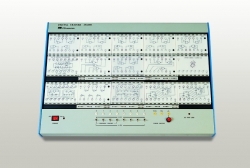
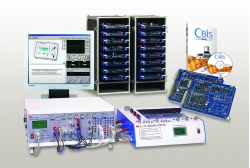
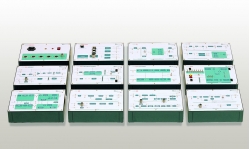
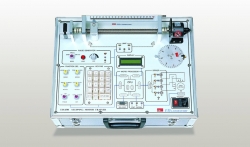
Pulse/Digital Communication Trainer ED-2920

Code: ED-2920


Datasheet PDF, 0.99 Mb

Description

EXPERIMENTS

  • PAM
    • To Understand PAM Signal Generation Which Makes an Example of Natural and Flat-Top
    • To Know the Impact of Sampling Signal Frequency on PAM Signal At the Time Domain
  • PTM
    • To Understand PTM (Pulse Time Modulation) Signal Generation Methods
    • To Understand PTM Signal Characteristics at the Time Domain
    • To Understand the Relationship Between PWM Signal and PPM Signal
  • PCM
    • To Understand A/D and D/A Conversion Processes
    • To Understand the cCounter-type A/D Conversion System
    • To Understand the Parallel-type D/A Conversion System
  • PCM
    • To Understand the Successive Approximation-type A/D Conversion System
    • To Understand PCM Signal Transmission Methods
  • PCM
    • To Understand the µ-law and µ-law Companding Characteristic Curves
    • To Understand the Influence of Companding on Demodulation Signal
  • DPCM
    • To Know the Methods of DPCM Signal Generation and Message Signal Demodulation
    • To Know the Offset Binary Code, 2’s Complement Code and Signed Binary Code
  • ADPCM
    • To Know the Relationship Between PCM CODEC’s Operation Principle and Its Timing
    • To Know the Relationship Between ADPCM System’s Operation Principle and ADPCM Transcoder’s Timing Diagram
  • LDM
    • To Know LDM Signal Generation and Message Signal Demodulation Methods
    • To Know the Shapes of Slope Overload Noise and Granular Noise Generated in ?M System
  • ADM
    • To Know ADM Signal Generation and Message Signal Demodulation Methods
    • To Know the Methods of Oblique Overload Noise Prevention in CVSD Demodulation System
  • ?-?
    • To Know ?-? Demodulation Principles and S/N Improvement Methods
    • To Know the Impact of Oversampling and Noise Shaping On the S/N Ratio at  ?-?Eemodulation


Features:

  • Modularized by each communicarion type
  • PAM, PTM, PCM, DPCM, ADPCM, LDM, ADM, Delta-sigma
  • No need to have additional generators (built-in power supply and signal source)
  • Can display the test point and measure signals using an oscilloscope
 

More products ED

EMBEDDED SOFTWARE DESIGN MULTI PLATFORM ED-270M

• Foundation for the Ubiquitous System Build
• Intel PXA 270 high performance processors
• 6.4TFT LCD, Ethernet 3Port, Serial 3Port, PCMCIA/CF/MMC interfaces
• FPGA Chip Altera Cyclone 4,000 LEs(12,000 LEs Option) for SoC courses
• Processor Core Board & CMOS Image Sensor


LOGIC/DIGITAL CIRCUIT TRAINER ED-1400A

• Capable of performing Logic monitoring functions
• Graphical presentation of functional diagram on each module
• 15 modules each for TTL or CMOS IC type


ELECTRICAL MACHINE TRAINER ED-5300

• 19 types of modules & graphic boards
• 25 types of electrical machine assembly
• Experimental board rack & storage trolley


PNEUMATICS TRAINER ED-7860

• Convenient parts fixation by ‘one-touch lever’ bases and aluminum profile structure
• Efficient space utilization by mounting parts horizontally/vertically
• A complete pneumatic training system to help achieve advanced level of skills and obtain pneumatic engineering related licensesOver


MICROPROCESSOR COMBO II ED-4513

• Mountable 5pieces MCU(8051,PIC, ATmega128, ATmega8535, upd78F0547)
• Practice of various communications such as RS-232 USB and Ethernet
• SoC experiments using the default FPGA (EP1C4F324)
• Storage of sensor data display and excel data using UI(LabVIEW)


SERVO UNIT TRAINER ED-4270M

• Experiments on various types of special control unit
• Characteristics of Servo Motor and setup of Servo Driver
• Essential components in automation using a PLC position module
• 4mm banana jack to increase wiring capability


DC MOTOR/AC GENERATOR MG-5214

• DC motor’s load characteristics
• DC motor’s loss and efficiency
• Alteration of the motor’s rotative directions
• Motor’s speed and torque


ASSEMBLING ROBOT TRAINER ED-7300

• Disassembly and assembly practices for the robot actuators
• Utilization of a robot being used in the industry, so to apply a job site after graduation
• Simulation software provided to make assembly or disassembly easily
• Enables basic operation and testing practices on the assembled unit using a controller


FLUID PROCESS CONTROL TRAINER ED-FPC

• Control of pressure, flow, level and temperature which are essential for process control
• Capable of stand-alone control and mixed combination in various types
• Real-time measurement and monitoring using data collection and signal conditioning
• Measurement of flow’s status and gain of the controlled data


SEQUENCE CONTROL TRAINER ED-4010

• Realistic arrangement of materials used for contact sequence
• Indication of each element’s symbol on the panel