Security Surveilance Detection Infrared Camera Flir F-Series
OBSOLET PRODUCT ( * OUT OF USE )

Code: Flir F-Series


Description

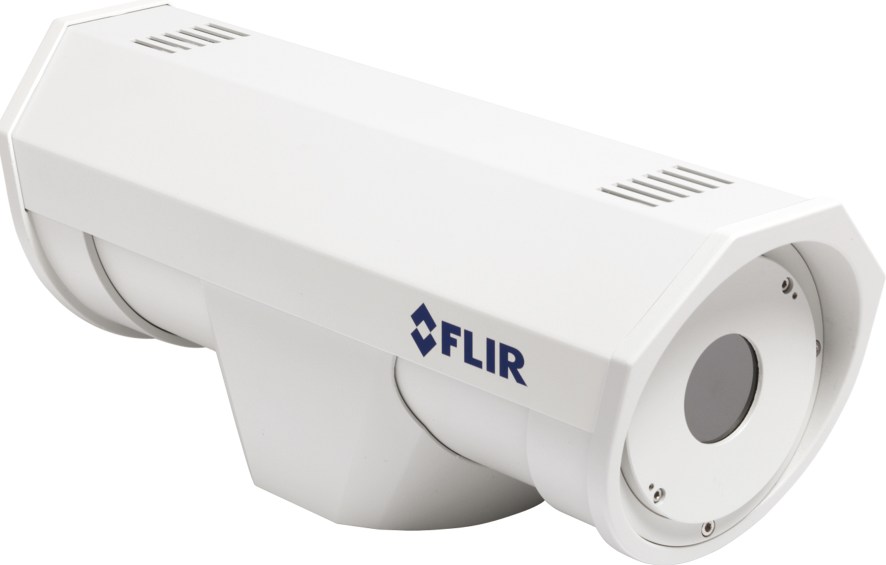
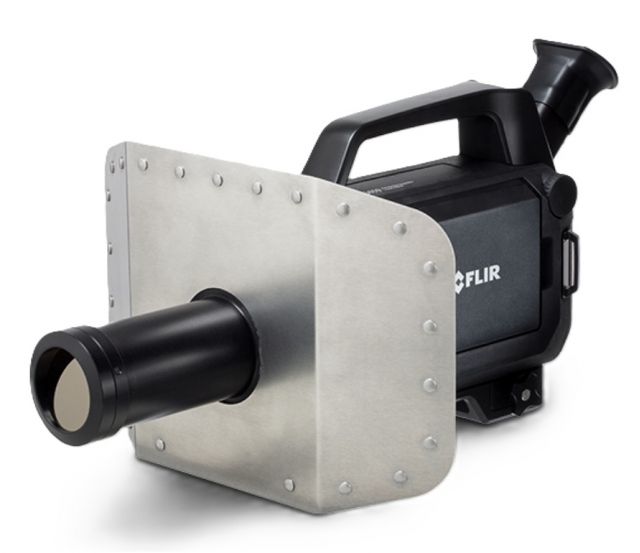
FLIR F-Series


F-Series thermal security cameras let you see intruders and other threats to your facility clearly in total darkness and in bad weather. Fully enabled for control and operation over digital and analog networks, F-Series thermal imaging cameras are available in 160 × 120, 320 × 240, and high-resolution 640 × 480 formats, providing up to sixteen times the image clarity and longer threat detection range performance than lower resolution cameras.


  • The user can choose for a version equipped with an uncooled Vanadium Oxide (VOx) microbolometer producing crisp images of 640 x 480 pixels. Users that do not need this image quality can choose for a 320 x 240 pixels version. Models with a 160 x 120 pixels detector are also available.
  •  
  • More pixels allow the user to see more detail and to detect more and smaller objects. Advanced internal camera software delivers a crisp image without the need for user adjustments. It provides high quality thermal imaging in any night- or daytime environmental conditions.
  • The F-Series provide high contrast imagery optimized to get the most out of video analytics software. Digital Detail Enhancement ensures clear, properly contrasted thermal images in all weather conditions.
  • Equipped with a 100 mm lens, the F-606 is designed for mid-range security and surveillance applications. The F-606 has a 6° field of view. With the F-606 you will be able to detect a man-sized target at a distance of over 2.4 km.
  • Equipped with an 'athermal lens', all F-Series are able to maintain focus no matter what the environmental temperature is. There is no need for user adjustments.
  • The F-Series are extremely rugged systems. Their vital core is well protected, meeting IP66 requirements, against dust and water ingress.
  • The absence of a motorized focus mechanism prevents mechanical break downs. The F-Series do not need any maintenance whatsoever. This guarantees an extremely low total cost of ownership.
  • Exchangeable camera cassettes allow for quick upgrade or repair of sensors and optics. There is no need to send your camera back to the factory if you want to upgrade to better image quality or more range performance. This can easily be done in the field.
  • The F-Series can be integrated in any existing TCP/IP network and controlled over a PC. No additional cables are required. Using this configuration, you can monitor all activity over the network, even when you are thousands of kilometers away.
  • Simply connect the F-Series over RS-232, RS-422 or RS-485 to a remote control panel. Pelco D or Bosch commands are used for common functions. A video cable can be connected to any existing multi-function display that accepts composite video.
  • Multiple channels of streaming digital video are available in H.264, MPEG-4, or M-JPEG formats. Simultaneous digital and composite video output is possible.
  • Each F-Series camera comes with a single sensor copy of FLIR Sensors Manager. This intuitive software allows users to manage and control an F-Series camera in a TCP/IP network.


Imaging performance

Detector type

Focal Plane Array (FPA), uncooled Vanadium Oxide (Vox) microbolometer

Spectral range

7.5 to 13µm

Thermal sensitivity

<50mK f/1.0

Image frequency

25 Hz or 8.3 Hz

Focus

Focus free, athermal lens

Image processing

Automatic Gain Control (AGC), Digital Detail Enhancement (DDE)


System features

Automatic heater

Clears ice from windows


Image presentation

Video output

PAL or NTSC

Video over Ethernet

Two independent channels of streaming MPEG-4, H.264, or M-JPEG


Power

Requirements

24 VAC (2&-30 VAC)

24 VDC (21-30 VDC)

Consumption

24 VAC: 51 VA max without heater
24 VDC: 46 W max without heater
24 VAC:  15 VA max without heater
24 VDC: 10 W max without heater


Environmental specification

Operating temperature range

-50 ° C  to  70° C.  (Cold start: -40° C to 70° C)

Storage temperature range

-50ºC to +85ºC

Encapsulation

IP66

Shock

IEC 60068-2-27

Vibration

Mil-Std-810F


Physical characteristics

Camera Weight

4.8 kg

Camera Size (L x W x H)

460 mm × 140 mm × 160 mm

Shipping weight (camera + packaging)

5.7 kg

Shipping size (camera + packaging) (L x W x H)

508 mm x 203 mm x 229 mm


Interfaces

TCP/IP

Yes

RS-422

Yes

RS-232

Yes

Pelco D

Yes

Bosch

Yes


Standard package

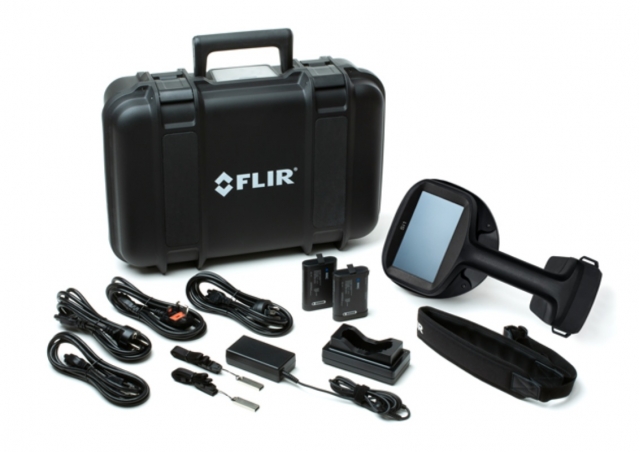
Thermal imaging camera, operator manual, FLIR Sensors Manager single sensor CD


Camera specific

Sensor resolution

160 x 120

320 x 240

640 x 480

Name/Focal length/ Field of view

F-124: 9 mm lens - FOV: 24°(H) × 20°(V)
F-117: 13 mm lens - FOV: 17°(H) × 14°(V)
F-112: 19 mm lens - FOV: 12°(H) × 10°(V)

F-348: 9 mm lens - FOV: 48°(H) x 39°(V)
F-334: 13 mm lens - FOV: 34°(H) x 28°(V)
F-324: 19 mm lens - FOV: 24°(H) x 19°(V)
F-313: 35 mm lens - FOV: 13°(H) x 10°(V)
F-307: 65 mm lens - FOV: 7°(H) x 5°(V)
F-304: 100 mm lens - FOV: 4.6°(H) x 3.7°(V)

F-645: 13 mm lens - FOV: 45°(H) × 37° (V)
F-625:  25 mm lens - FOV: 25° (H) × 20°(V)

F-618: 35 mm lens - FOV: 18° (H) × 14°(V)
F-612: 50 mm lens - FOV: 12° (H) × 10°(V)
F-610: 65 mm lens - FOV: 10° (H) × 8°(V)
F-606: 100 mm lens - FOV: 6.2° (H) × 5°(V)

Electronic zoom

2x

2x and 4x

2x and 4x


Standard accessories

  • Thermal imaging camera
  • operator manual
  • FLIR Sensors Manager single sensor CD
 

More products FLIR

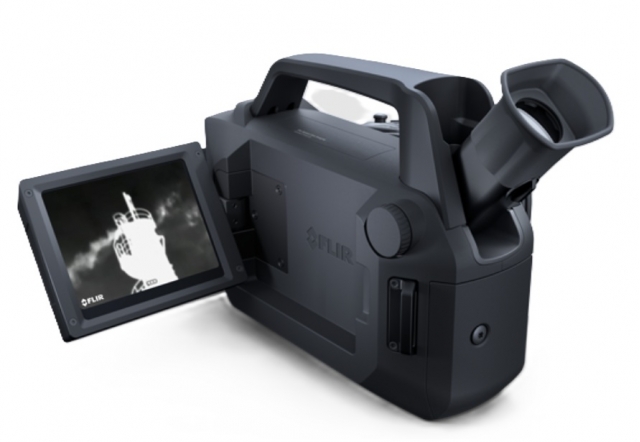
FLIR G304 INFRARED CAMERA FOR DETECTION OF HYDROFLUOROCARBON, REFRIGERANT, AND OTHER INDUSTRIAL GASES IN PRODUCTION FACILITIES AND CHEMICAL PLANTS

• The FLIR G304 is an innovative Optical Gas Imaging (OGI) camera
• used to detect possible hydrofluorocarbon, refrigerant, and other industrial gases in production facilities and chemical plants.


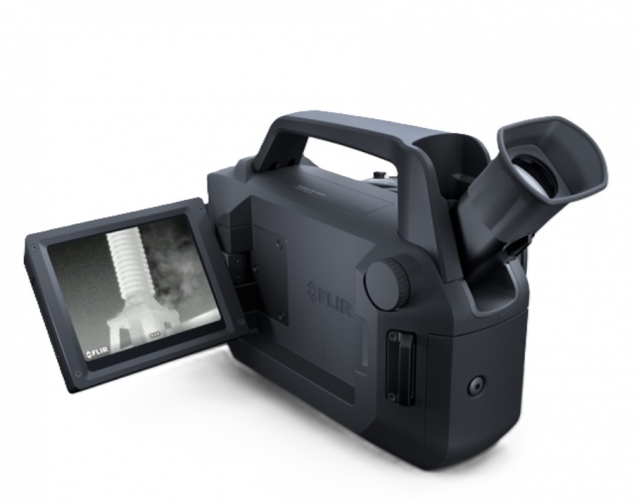
FLIR G306 INSPECTION GAS CAMER FOR HEXAFLUORID AMONIUM ETYLENE SF6 NH3 C2H4

• The FLIR G306 is an innovative Optical Gas Imaging (OGI) camera
• used to visualize sulfur hexafluoride (SF₆), ammonia (NH₃), ethylene (Câ‚‚Hâ‚„), and other industrial gas leaks in various environments.


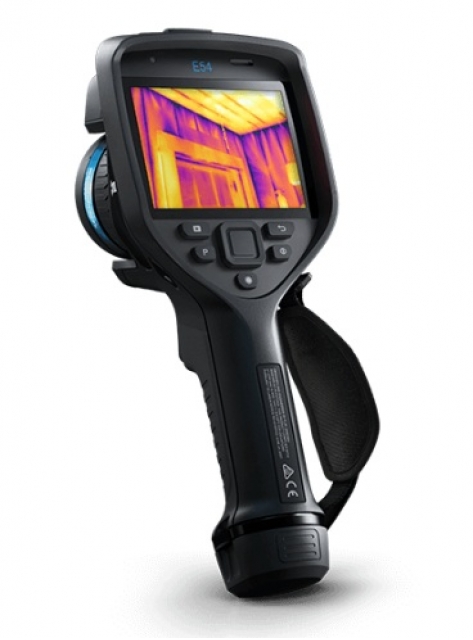
FLIR E54 THERMAL INFRAERD CAMERA 320X240PXL

• 320 × 240 thermal imaging
• Measures temperatures up to 550°C (1022°F)
• 1-Touch Level/Span adjustable contrast


FLIR I35 INFRARED CAMERA WITH APP AND LTE 240X320PXL

• App-Enabled Thermal Imaging Camera with LTE
• 240 × 320 thermal resolution
• <40 mK NETD


FLIR CX5 COMPACT INFRARED CAMERA WITH ATEX EXPLOSION PROOF FOR HAZARDOUS LOCATION

• Flir C5 features + ATEX housing
• 160 × 120, max temp. 400°C (752°F)
• 1-Touch Level/Span adjustable contrast


FLIR C8 COMPACT INFRARED CAMERA

• 320 × 240 thermal resolution
• Measures temperatures up to 450°C (842°F)
• 1-Touch Level/Span adjustable contrast


FLIR G343 INFRARED CAMERA FOR CARBON DIOXIDE EMISSIONS CO2

• The FLIR G343 is an innovative Optical Gas Imaging (OGI) camera
• used to visualize possible carbon dioxide (COâ‚‚) gas leaks in complex systems including enhanced oil recovery, carbon capture systems, and hydrogen-cooled power generators.


FLIR G609 HIGH TEMPERATURE BOILER FURNACE INSPECTION HEATER

• The FLIR G609 is designed to streamline inspections in high temperature industrial furnace applications
• These infrared cameras are ideal for monitoring all types of furnaces, heaters, and boilers, particularly in the chemical, petrochemical, and utility industries


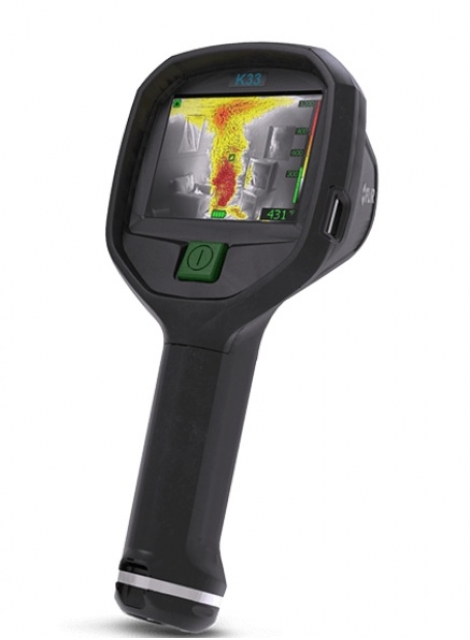
FLIR K33 INFRARED TERMAL CAMERA FOR FIREFIGHTING FIREFIGHTER

• High-Performance TIC Termal infrared camera 240×180
• The Flir K33 thermal imaging camera with new
• enhanced imaging is the solution fire departments need to ensure every firefighter has a TIC in the field.


FLIR SI2-LD ACOUSTIC CAMERA FOR AIR LEAK DETECTIONS AND MECANIC FAULTS BEARING

• Detects, locates, and measures compressed air and gas leaks;
• including bearing fault detection, from up to 200 m (656 ft) away
• Built-in measurement and cost analysis for industrial gases including ammonia, hydrogen, CO2, methane, helium, and argon
• One-handed operation with automatic tuning, 8x zoom, and a 12 MP digital camera
• Mechanical fault mode, automatic selection, and optimization of filters simplifies finding critical mechanical issues, such as bearing
• faults