Privacy policies
GDPR data Terms of use Cookies policy Privacy policy Delivery and Payment How to order?
Privacy policies
GDPR data Terms of use Cookies policy Privacy policy Delivery and Payment How to order?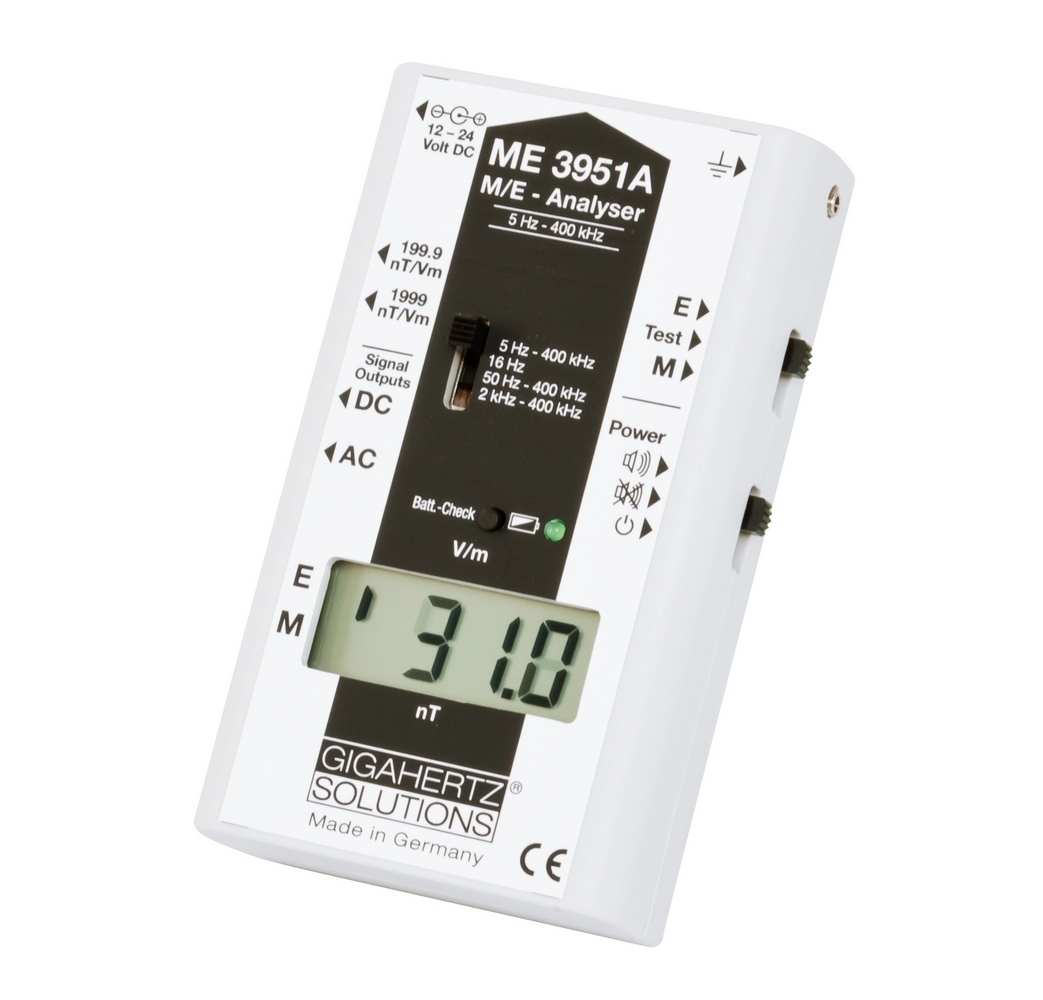

Code: Gigahertz Solutions - LOW FREQUENCY ANALYSER ME3951A
 Datasheet
 PDF, 0.31 Mb
Description
This meter covers the full TCO bandwidth, and is therefore predestined for the professional user. Its functions and features are tailored to the needs and practical experience of the building biology. Due to its comparably low price, it is often also used for scientific and industrial purposes.
Frequency range: 5 Hz - 400 KHz (compensated, better than -2 dB).
Switchable, internal frequency filter: 16.6 Hz bandpass, 50 Hz highpass, 2 kHz highpass for the identification and evaluation of sources of pollution
Features:
More products GIGAHERTZ
GIGAHERTZ SOLUTIONS - HF-ANALYZER HFE35C-BASIC
• Audio analyses for the identification of pulsed radiation sources (mobile radio (GSM, UMTS/G3), cordless telephones (DECT), WLAN (Bluetooth), air-traffic control radar) by means of an acoustic signal proportional to the modulation frequency. |
GIGAHERTZ SOLUTIONS - LOW FREQUENCY ANALYSER ME3840B
• The measured values are reliably displayed directly in the entity corresponding to the building biology standard values, namely: |
GIGAHERTZ SOLUTIONS - 3D-MAGNETIC FIELD DATA LOGGER NFA30M
• Allows longterm measurements of the magnetic field as required in the guidelines for sleeping place measurements. |
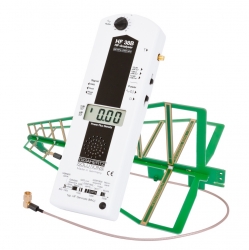
GIGAHERTZ SOLUTIONS - HF-ANALYSER HF38B
• A 10 times higher sensitivity: Minimum display resolution 0.01 µW/m² . |
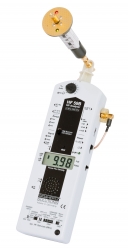
GIGAHERTZ SOLUTIONS - HF-ANALYSER HF59B
• A frequency range of down to 27 MHz within the basic device - suitable for the connection of the optionally available antenna UBB27_G3 (the scope of delivery includes a compensated antenna for 800 MHz up to 2.7 or 3.3 GHz). |
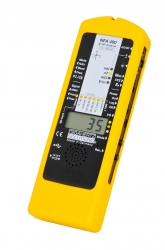
GIGAHERTZ SOLUTIONS - 3D-LF-ANALYSER WITH DATA LOGGER NFA400
• ONE-dimensional potential-free measurement of the electric field (Y-axis). |
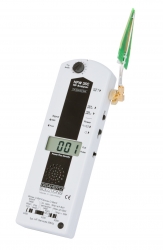
GIGAHERTZ SOLUTIONS - HF-ANALYSER HFW35C
• Frequency range from 2.4 to 6 GHz. |
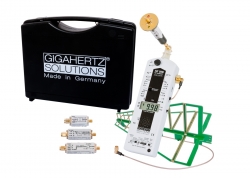
GIGAHERTZ SOLUTIONS - HF-ANALYSER KIT HFE59B
• Horizontal isotropic ultra broad bandwidth antenna UBB27_G3 from 27 MHz up to beyond 3.3 GHz (limited by the frequency response of the HF59B). |
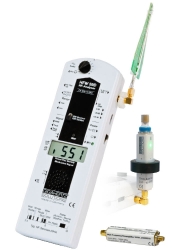
GIGAHERTZ SOLUTIONS - HF-ANALYSER SET HFW59D PLUS
• Maximum video band width for the demonstration of the shortest radar pulses (< 0.5 µs). |
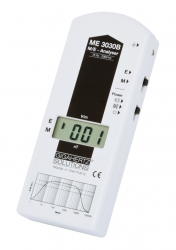
GIGAHERTZ SOLUTIONS - LOW FREQUENCY ANALYSER ME3030B
• The reading shows the total pollution without any calculation required. |